From a ticket price to a connected financial decision model.
How an event-pricing exercise became a practical way for organizers to understand the resources needed, see how cost and revenue assumptions interact, and make better-informed trade-offs.
The challenge
An event needs to be financially achievable, not merely well-attended. Organizers faced interdependent assumptions about ticket prices, registration volumes, sponsorship, catering, fixed expenses and how much of the budget should be protected. A single ticket-price figure could not reveal the wider consequences.
The approach
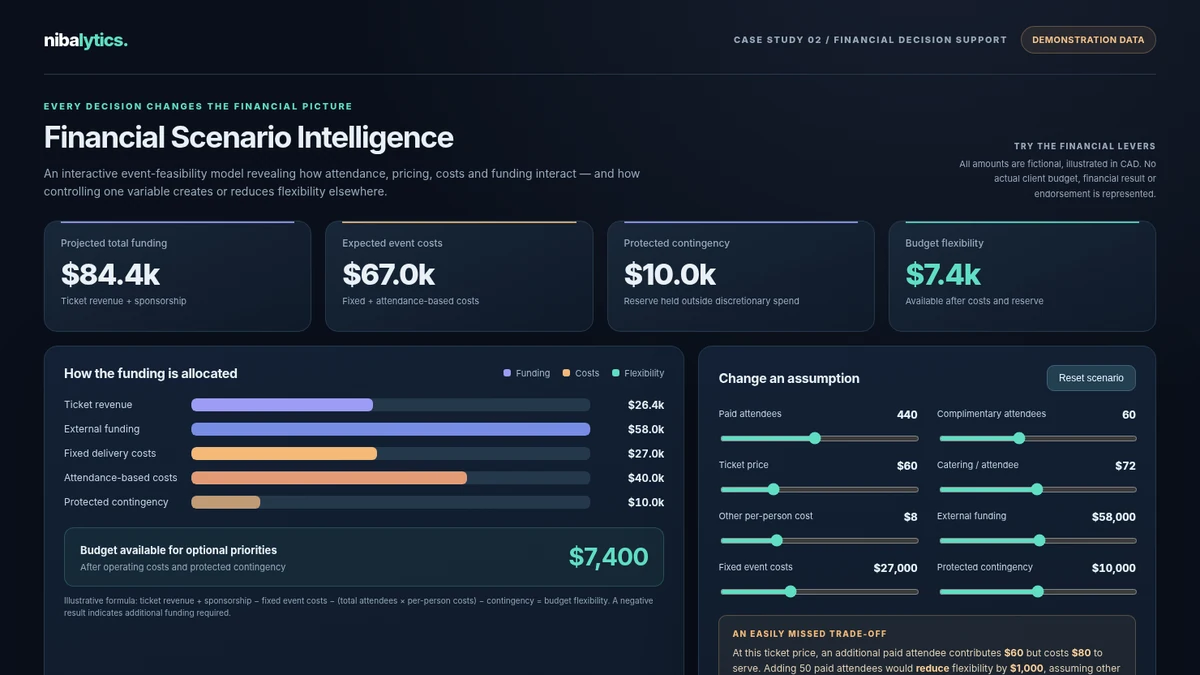
The analysis brought those decisions into one adjustable model. Rather than producing one forecast, the model let organizers test questions such as: if we reduce one cost, how much capacity is released elsewhere? If attendance increases, does the event actually become more sustainable?
The model connected the decisions
Paid attendance, ticket price, complimentary attendance, sponsorship and other expected resources.
Fixed costs and variable expenses that change with attendance, including catering and related services.
A deliberate buffer that keeps the model from treating all available revenue as freely spendable.
After funding and costs are combined, the model shows what remains available for other event priorities or what extra funding is required.
The insight that changed the discussion
The useful question was no longer simply “What should we charge?” It became “Which variable can we control, and what does that make possible somewhere else?”
Under certain assumptions, adding attendees did not improve the financial position because the incremental cost per person exceeded the revenue they brought. Reducing a per-person expense or securing additional sponsorship could, in contrast, create measurable flexibility for other needs.
According to the project lead, reviewing the connected calculations surprised organizers and gave them a clearer framework to assess the financial resources necessary to deliver the event. The model made dependencies and trade-offs visible rather than leaving them implicit.
Try the financial scenario model
Change ticket prices, attendance, sponsorship, catering, fixed costs or contingency to see how those levers affect the available budget. Each adjustment recalculates the overall financial position.
Make the trade-offs visible before committing resources.
From event pricing to operational budgets and business planning, NibaLytics builds models that help people understand assumptions, test alternatives and make informed financial decisions.
Discuss a similar project